Table of Contents
Learning Objectives
- Define what an agentic system is in the context of Claude
- Explain how agentic systems differ from standard API calls
- Identify the core components of a Claude agentic system
- Describe real-world use cases where agentic systems are appropriate
What Is an Agentic System?
Defining an agentic system
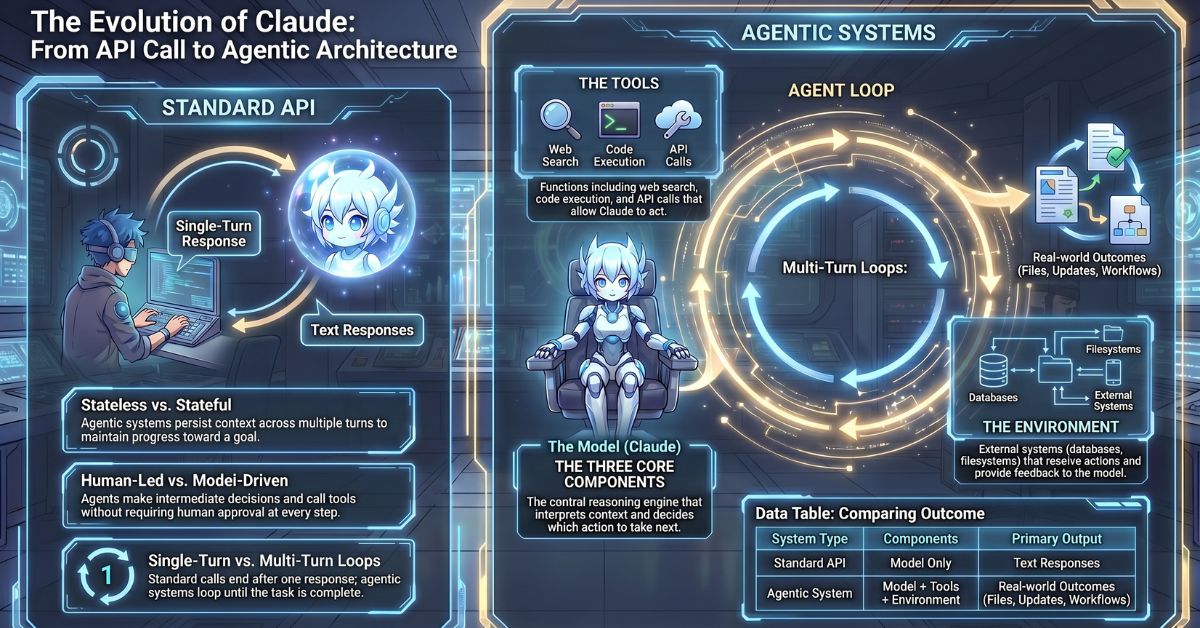
A standard Claude API call is a single-turn interaction: you send a prompt, Claude returns a response, and the transaction is complete. An agentic system is something fundamentally different. In an agentic context, Claude operates across multiple steps, calling tools, evaluating intermediate results, making decisions based on those results, and continuing execution — all without waiting for a human to intervene at each step.
Anthropic defines agentic settings as those where Claude must take sequences of actions or plan and make a series of decisions to complete longer-horizon tasks. The word autonomous is central here. The model is not merely responding to a single instruction; it is pursuing a goal through a sequence of actions, with the environment itself providing feedback that shapes subsequent steps.
This matters for the exam because the CCA-F distinguishes sharply between agentic and non-agentic use cases. Understanding this boundary is foundational to every topic in Module 1.
How agentic systems differ from a single API call
The contrast is clearest across three dimensions: state, turns, and tool access.
Standard API call:
- Stateless — no memory between calls
- Single-turn — one prompt, one response
- Response only — text output, nothing executed
- Human controls every step
Agentic system:
- Stateful — context persists across steps
- Multi-turn — model loops until goal is met
- Tool-using — reads files, calls APIs, writes output
- Model drives intermediate decisions
A developer calling /v1/messages to classify support tickets is making standard API calls. That same developer building a pipeline where Claude reads a ticket, queries a knowledge base, drafts a reply, and logs the outcome to a database — without human approval at each step — has built an agentic system. The distinction is not about Claude’s capability; it is about who or what controls the sequencing of decisions.
The three core components
Every Claude agentic system is built from three elements. These components appear repeatedly in exam questions, so internalising them is non-negotiable.
1. The model (Claude) The reasoning engine. Claude interprets the current context, decides which action to take next, and determines when the goal has been met.
2. The tools Functions Claude can invoke during execution — web search, code execution, file read/write, database queries, external API calls. Tools are what give the model the ability to act on the world rather than merely describe it.
3. The environment The external systems Claude interacts with — file systems, databases, browsers, third-party APIs, or other agents. The environment receives Claude’s actions and returns results that feed into the next step.
The model alone produces text. Add tools and an environment and it produces outcomes: files written, records updated, workflows triggered. The quality and safety of an agentic system depend heavily on how these three components are designed to interact.
When to use an agentic system vs a simpler API call
Not every task warrants agentic complexity. The decision to build an agentic system is justified when one or more of the following conditions hold.
Task complexity: The goal cannot be achieved in a single prompt-response exchange. It requires planning, branching logic, or iterative refinement across multiple steps.
Tool use is necessary: Answering the question or completing the task requires Claude to read from or write to external systems — a database, an API, a file system.
Multi-step reasoning: The output of one step must inform the inputs of the next, and that dependency chain is too long or dynamic to resolve in a single context window.
Conversely, if your task is “summarise this document” or “translate this paragraph,” a standard API call is the correct choice. Introducing agentic overhead without justification increases cost, latency, and failure surface area.
Real-world examples for developers
Code review pipeline. Claude receives a pull request diff, calls a static analysis tool to retrieve linting results, queries a test coverage API, evaluates both outputs, and writes a structured review comment back to the repository. No human approves each intermediate step; Claude drives the sequence from diff to comment.
Document analysis and extraction. A legal team uploads a folder of contracts. Claude reads each document, extracts clause-level data — termination terms, governing law, liability caps — cross-references against a compliance checklist, and writes a structured report to a spreadsheet. The pipeline handles dozens of documents without per-document human instruction.
Multi-step research agent. A user asks Claude to produce a competitive analysis. Claude searches the web, fetches relevant pages, synthesises findings across sources, identifies gaps, runs additional targeted searches, and produces a structured output — all within a single agent run. The user receives a finished document, not a list of links.
In each case, the common thread is that Claude is making intermediate decisions — what to fetch, what to prioritise, what counts as sufficient — rather than simply executing a single instruction.
Introduction to the agent loop
The mechanism that makes all of the above possible is the agent loop: a repeating cycle in which Claude generates a response, that response may include a tool call, the tool executes and returns a result, and Claude receives that result as new context before deciding its next action. This loop continues until Claude determines that the goal has been achieved or that it cannot proceed.
The agent loop is the structural engine of every agentic system. Lesson 1.2 covers it in depth — including how tool results are injected into context, how the loop terminates, and how to reason about failures within the loop. For now, the key point is that the loop is what separates agentic execution from single-turn API calls: the model is continuously consuming new information and acting on it.
Key Takeaways
- An agentic system is one in which Claude takes sequences of actions across multiple steps, using tools and making intermediate decisions without continuous human input.
- The critical distinction from a standard API call is statefulness, multi-turn execution, and tool access — all three together define the agentic pattern.
- Every Claude agentic system is composed of three components: the model, the tools it can call, and the environment it operates in.
- The agent loop — the repeating cycle of model output, tool execution, and result ingestion — is the structural mechanism that enables autonomous multi-step behaviour.
What Is Tested
In CCA-F scenario questions on this topic, candidates are typically presented with a described use case and asked to determine whether it warrants an agentic architecture or a standard API call, and to identify which components of the agentic system are present. The question format often describes a workflow — a document processing pipeline, an automated outreach system, a code generation tool — and requires the candidate to name the model, the tools involved, and the environment being acted upon. Misidentifying a simple prompt-response workflow as agentic, or failing to recognise tool use as a prerequisite indicator of agentic design, are the most common error patterns at this level.