Table of Contents
Learning Objectives
By the end of this lesson, you will be able to:
- Describe each phase of the observe-think-act-respond cycle
- Explain what happens inside Claude at each phase
- Identify where failures most commonly occur in the cycle
- Relate the cycle to real production agentic deployments
The Observe-Think-Act-Respond Cycle
What the Cycle Is
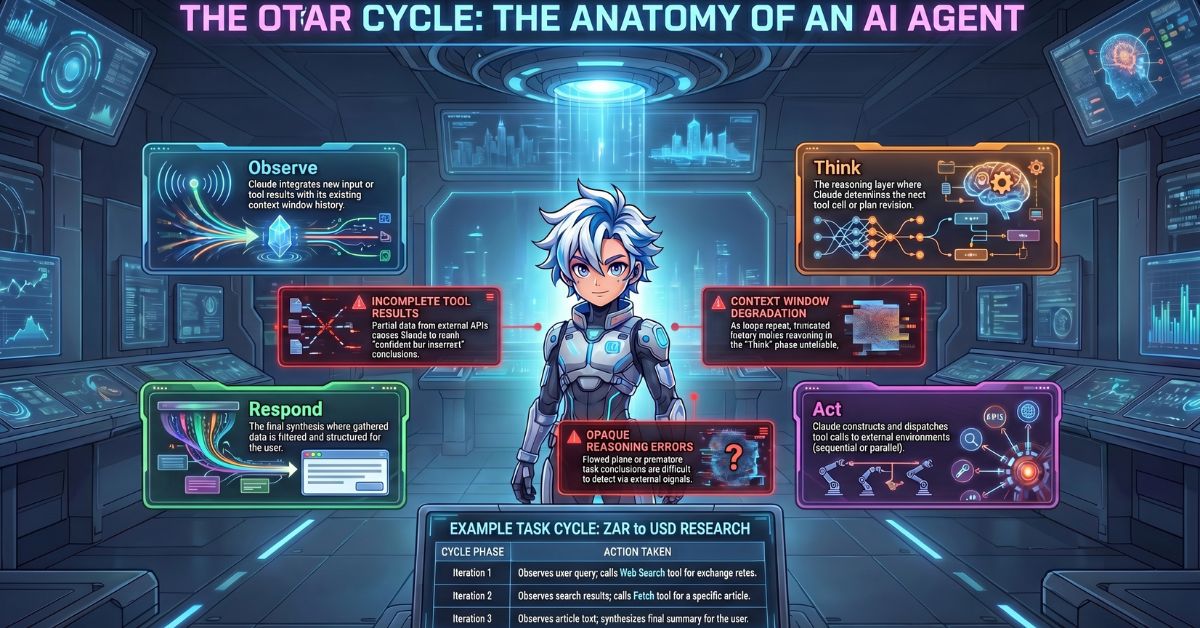
When Claude operates as an agent, it does not process a single input and produce a single output. Instead, it executes a repeating loop: observe, think, act, respond. This cycle continues for as many iterations as the task requires, with each loop building on the results of the previous one.
Understanding this cycle is foundational to designing reliable agentic systems. Every architectural decision you make as a Claude architect — how you structure tools, manage context, handle errors — affects how cleanly Claude can traverse each phase. Candidates who grasp the cycle at a mechanical level are far better equipped to diagnose production failures and reason through exam scenarios.
Observe: Receiving Input
The cycle begins when Claude receives input. In the first iteration, this is typically a user message — a natural language instruction, a structured prompt, or a combination of both. In subsequent iterations, the input is a tool result: the raw output returned by a search engine, a database query, an API call, or any other tool Claude has invoked.
The observe phase is not passive. Claude does not simply log the incoming data. It integrates the new input with everything already present in its context window — prior messages, previous tool results, system prompt instructions, and any injected state. The context window is the entire working memory Claude has access to at this point in the loop. What Claude observes is therefore a composite: new information layered on top of accumulated history.
This phase is where context loss becomes dangerous. If prior tool results have been truncated, summarised incorrectly, or dropped entirely due to context window constraints, Claude enters the think phase with an incomplete picture. That incompleteness propagates through every subsequent phase.
Think: Reasoning and Planning
Once Claude has integrated the incoming input, it reasons. The think phase is where Claude determines what to do next. It considers the original instruction, the current state of the task, the results it has already gathered, and the tools available to it.
During this phase, Claude makes several determinations:
- Has sufficient information been gathered to produce a final response?
- If not, which tool should be called next, and with what parameters?
- Are there dependencies between the next action and information not yet retrieved?
- Does the current plan still hold, or does the new input require a revised approach?
This is Claude’s planning layer. In production systems, the quality of the think phase depends heavily on how clearly the system prompt defines Claude’s goals, the tools available, and any constraints on behaviour. Ambiguous instructions or poorly documented tools increase the probability of reasoning errors — for example, calling the wrong tool, constructing a malformed query, or concluding the task is complete when it is not.
The think phase is the most opaque part of the cycle from an observability standpoint. You cannot inspect Claude’s internal reasoning directly. You can only infer it from the actions that follow.
Act: Executing Tool Calls
When Claude determines that a tool call is necessary, it moves into the act phase. It constructs the tool call — specifying the tool name and the required parameters — and dispatches it. The tool executes in whatever environment it is hosted, and returns a result.
Claude may execute tools in sequence or, where the architecture supports it, in parallel. Sequential tool use means each tool result informs the next tool call. Parallel tool use means multiple tools are called simultaneously, with Claude waiting for all results before proceeding. Sequential execution is more common in practice because later tool calls often depend on the output of earlier ones.
The act phase introduces external dependencies. Claude does not control what the tool returns. A search API may return irrelevant results. A database may return an empty set. An external service may time out. Each of these outcomes affects what Claude has available when it re-enters the observe phase. Robust agentic architectures handle these contingencies explicitly — through error handling instructions in the system prompt, fallback tool definitions, or retry logic.
Respond: Synthesising Output
When Claude determines it has gathered sufficient information, it exits the act phase and produces output. In the respond phase, Claude synthesises the tool results accumulated across all iterations and constructs a response — to the user, to a downstream system, or to an orchestrating process.
The respond phase is not simply concatenation. Claude interprets, filters, and structures the accumulated data in line with the original instruction and any formatting requirements specified in the system prompt. The quality of the response depends on the integrity of the information gathered in prior phases.
In multi-agent architectures, the respond phase of one agent may constitute the observe phase of another. Claude’s output becomes the input to the next system in the pipeline. This means errors in the respond phase can propagate downstream, making output validation an important architectural concern.
How the Cycle Repeats
After Claude acts and receives a tool result, it re-enters the observe phase. The tool result is new input. Claude integrates it with the existing context and begins thinking again. This loop continues until Claude determines the task is complete and transitions to the respond phase.
The number of iterations is not fixed. Simple tasks may complete in a single cycle. Complex research or multi-step workflows may require five, ten, or more iterations. Each iteration consumes context window space, which means long-running agentic tasks must be designed with context management in mind.
Where Failures Occur
Three failure points recur most often in production deployments:
Incomplete tool results degrade the observe phase. If a tool returns partial data — due to pagination, rate limiting, or a malformed query — Claude reasons from an incomplete picture. This frequently produces confident but incorrect conclusions.
Context loss between iterations compounds over time. As the context window fills, older information may be truncated. If Claude loses access to the original instruction or an earlier tool result, its reasoning in the think phase becomes unreliable.
Reasoning errors in the think phase are the hardest to detect and the most consequential. A flawed plan — calling the wrong tool, misinterpreting a constraint, or concluding a task is complete prematurely — propagates through the act and respond phases without any external signal that something has gone wrong.
A Worked Example: Web Research Task
Consider a simple instruction: “Find the current exchange rate between the South African rand and the US dollar, and summarise the key factors affecting it.”
Iteration 1:
- Observe: Claude receives the user instruction.
- Think: Claude determines it needs current exchange rate data and plans a web search.
- Act: Claude calls the web search tool with the query “ZAR USD exchange rate today”.
- The tool returns a results page.
Iteration 2:
- Observe: Claude receives the search results and integrates them with the original instruction.
- Think: Claude identifies a relevant source and plans to fetch the full article.
- Act: Claude calls a fetch tool to retrieve the article content.
- The tool returns the article text.
Iteration 3:
- Observe: Claude receives the article content.
- Think: Claude determines it now has sufficient information to produce a response.
- Respond: Claude synthesises the exchange rate data and contextual factors into a structured summary for the user.
Each phase is traceable. Each transition has a clear trigger. This traceability is exactly what the exam tests.
Key Takeaways
- The observe-think-act-respond cycle is the foundational execution loop for all Claude agentic behaviour.
- Each phase has a distinct function: integrating input, planning action, executing tools, and producing output.
- Failures most commonly occur when tool results are incomplete, when context degrades across iterations, or when the think phase produces a flawed plan.
- Understanding where a failure sits within the cycle is the first step toward diagnosing and resolving it in a production system.
What Is Tested
Exam questions on this topic require candidates to trace the observe-think-act-respond cycle through a described scenario, identifying the specific actions Claude takes at each phase and the transitions between them. Candidates may also be asked to attribute a described failure — such as a hallucinated tool parameter or a premature task conclusion — to the phase in which it originates. A third category of question asks candidates to explain precisely what Claude does between receiving a tool result and producing its next output, testing whether they understand the observe and think phases as active, reasoning-intensive steps rather than simple data-passing operations.