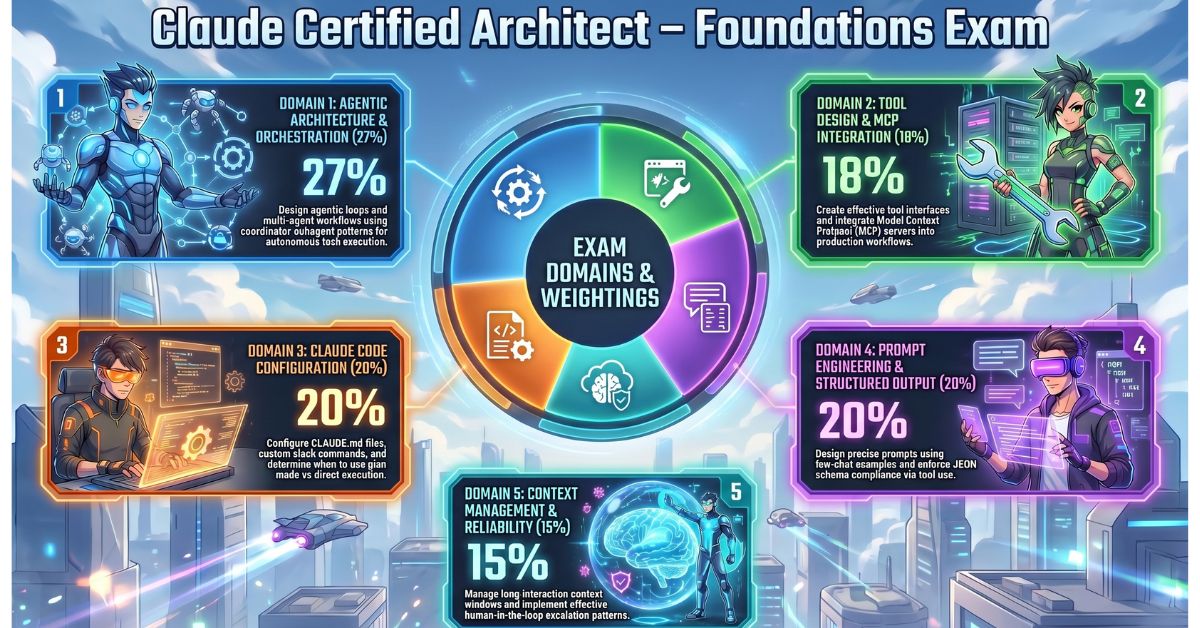
The Claude Certified Architect — Foundations (CCA-F) is Anthropic’s first official certification for engineers who design and deploy production-grade Claude AI applications. This course prepares you to pass the exam — 60 questions, 120 minutes, a pass score of 720 out of 1000 — by working through all five exam domains in structured, practical lessons.
The exam is not a test of basic Claude usage. It is a systems design and architecture assessment covering agentic orchestration, Claude Code configuration, prompt engineering, MCP tool integration, and context management. Each of these domains carries a defined exam weighting, and this course maps directly to that blueprint.
Every lesson is written for developers and technical professionals who are already building with AI. There are no introductory definitions of what a large language model is. Instead, each lesson focuses on the architectural decisions, design patterns, and reliability principles that the exam tests — and that production deployments demand.
Domain 1: Agentic Architecture & Orchestration (27%)
Highest-weighted domain. Prioritise this module.
- Agentic Architecture and Orchestration
- The Observe-Think-Act-Respond cycle
- Multi-agent system design principles
- Hub-and-spoke orchestration models
- Task decomposition strategies for complex workflows
- Subagent roles: orchestrators, workers, validators
- Safety and reliability patterns in agentic deployment
Domain 2: Tool Design & MCP Integration (18%)
- What is the Model Context Protocol (MCP)?
- MCP architecture: servers, clients, and transports
- Designing tools: inputs, outputs, and descriptions that Claude reasons well with
- MCP resources and prompt primitives
- Tool boundaries: preventing reasoning overload
- Authentication and security patterns in MCP
- Local vs remote MCP servers
- Real-world integration scenario: connecting Claude to an external data source
Domain 3: Claude Code Configuration & Workflows (20%)
- Introduction to Claude Code and the CLI
- CLAUDE.md: structure, hierarchy, and best practices
- Project-level vs global configuration
- Custom slash commands: creation and use cases
- Hooks: pre- and post-tool automation
- CI/CD pipeline integration patterns
- Team workflow conventions and shared configuration
- IDE integrations (VS Code, JetBrains)
Domain 4: Prompt Engineering & Structured Output (20%)
- System prompts vs user prompts: scope and purpose
- Few-shot prompting techniques and when to apply them
- Chain-of-thought and extended thinking patterns
- XML tags for structured instructions and output parsing
- Enforcing JSON schema in Claude responses
- Validation and retry loops for output reliability
- Handling ambiguity and refusals gracefully
- Scenario workshop: building a structured output pipeline
Domain 5: Context Management & Reliability (15%)
- Claude’s context window: limits and behaviour
- Long-context preservation strategies
- Multi-turn conversation state management
- Agent handoff patterns and memory approaches
- Confidence calibration and uncertainty signalling
- Error handling, retries, and graceful degradation
- Production reliability checklist